

One question for each 2026 World Cup team. Can Michael Olise and Rayan Cherki overcome Didier Deschamps instincts to make France boring?
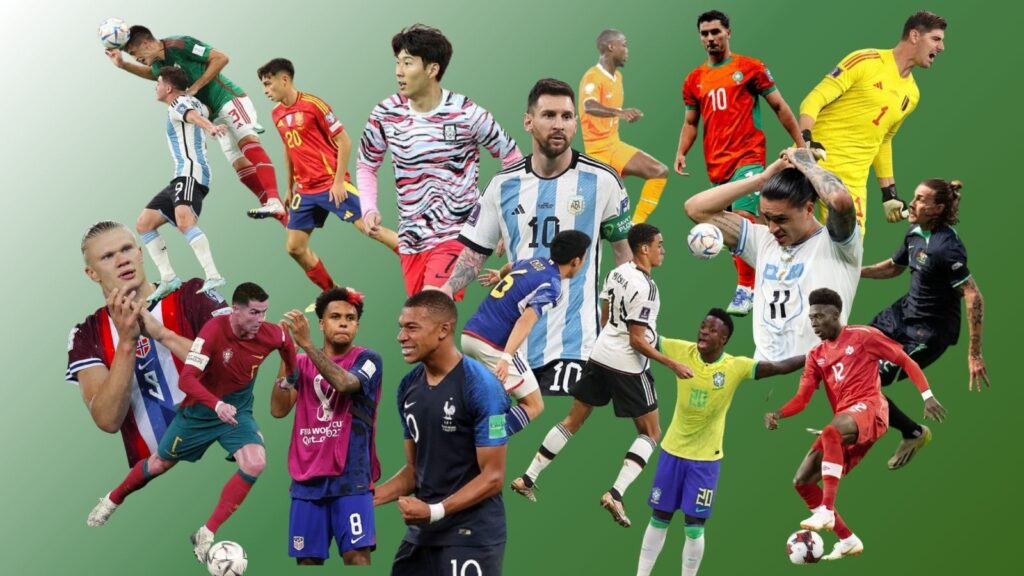
Would you love me in a Bentley? Would you love me on a $95 bus from downtown Boston to Gillette Stadium? Footnote is asking 48 questions, and they’re all about the 48 teams at the 2026 World Cup. This post is part of our Group I preview. You can also read previews of Norway, Senegal, and Iraq.
Can Michael Olise and Rayan Cherki overcome Didier Deschamps instincts to make France boring?
At the turn of the century, the French men’s national team established a World Cup rhythm that was probably deeply frustrating to French supporters but incredibly amusing to everyone who wasn’t a France fan but also didn’t mind seeing them win every so often.
In 1998 they hosted and won the World Cup. In 2002 they imploded and exited the tournament in the group stage. Then in 2006 they came just about as close to winning the tournament as you can without actually winning, just a Zinedine Zidane headbutt and a missed David Trezuguet penalty from defeating Italy in the final. Four years later in South Africa, they somehow imploded to an even greater extent than at the 2002 tournament, with no wins, two losses, and one infamous player mutiny.
But something clicked when Dideir Deschamps became coach in 2012. In the six major tournaments since Deschamps took charge of Les Bleus, they have only failed to reach the quarterfinals once — and that was in a round of 16 penalty shootout to Switzerland. That run also includes a World Cup win, and second-place finishes at Euro 2016 and the 2022 World Cup.
Deshamps accomplished this in part by creating a deeply pragmatic team. He emphasizes control above all, infamously using defensive midfielder Blaise Mattuidi as a winger to offset Kylian Mbappé in 2018. With the exception of the occasional game when they are pushed to score several goals, the France teams of the past decade win narrow, tightly fought contests in which they keep their opposition at arm’s reach as much possible
You can’t argue with results, but we’re talking about France here, so actually you can argue with just about anything. Throughout his tenure as manager, Deschamps has been constantly criticized for playing boring football.
Partially that is because when fans get used to winning, they start to demand being entertained. But partially that is because Deschamps has access to possibly the greatest talent pool in the history of international football and still decides to play more conservative soccer.
It feels like every block of the Paris suburbs, the ring of apartment blocks and immigrant communities that encircle the historic center city. is full of young kids with great first touch. It was players from immigrant communities, largely with roots in former colonies in North Africa, Francophone West Africa, and the Caribbean, that helped France first become a true world power. This was the famous Black-Blanc-Beur (Black-White-Arab) 1998 team that featured stars whose families came from Algeria and Senegal and Martinique to raise their children in Paris and Marseille.
To this day, kids around Paris grow up playing soccer constantly, both in organized games with youth clubs and in neighborhood parks, and then the best ones get picked up by Clairefontaine — the semi-mythical national training center that offers training to the best players in the country aged 10-14.
But the centrality of Clairefontaine can be overstated, and part of the reason there have been so many great French players in the past three decades is that the club academies have also gotten really good at turning soccer-obsessed kids into elite soccer players. Olympique Lyonnais’s academy is legendary but it is not alone: A recent analysis by CIES ranked PSG, Lyon, Stade Rennais, and AS Monaco among the 10 academy systems producing the most players in the top five European leagues.
The French talent factory at this point produces more international-calibre players than the French national team can possibly accommodate. At the 2025 Africa Cup of Nations, there were more players born in the Île-de-France administrative region than in any single African nation.
And there may now finally be too many fun French players for Deschamps to keep them all out of the starting lineup. Kylian Mbappé remains one of the most electrifying players in Europe, but the emergence of two new superstars in Rayan Cherki and Michael Olise, as well as the reemergence of Ousmane Dembélé mean that it is now hard to imagine a France starting XI that doesn’t play at least slightly interesting football.
Cherki is the most recent player of the group to emerge for the national team, but he’s had a surprisingly long career already. Cherki broke through at Lyon at just 16 years old, and played nearly 150 games for the club before moving to Manchester City last summer.
There are lots of great stats about how good Cherki is as a creator and a dribbler. Last season, he was in the 90th percentile in Europe for successful dribbles, and the 91st percentile for progressive carries, and the 99th percentile for final third entries.
But the main thing about Rayan Cherki is that he rules, and does cool things on a soccer field all of the time.
But also there’s Michael Olise. A smooth dribbling left-footed attacker, Olise comes to the World Cup after a truly insane season of production for Bayern Munich. Olise totalled 15 goals and 19 assists in the Bundesliga last season, which comes out to 1.32 goals and assists per 90 minutes. He has ascended to a rare tier of the elite goal creators in Europe, someone who can unlock a defense with a pass or a dribble at any moment.
Speaking of the elite goal creators in Europe, Ousmane Dembélé has taken a long route to get there, but he’s there now. The reigning Ballon d’Or winner, Dembélé was weighed down by a €105 million transfer to Barcelona that he never quite lived up to. But two seasons with Luis Enrique at PSG have unlocked his talents. A truly two footed player, Dembélé has been able to play as a central striker for PSG, enabling him to drift all over the pitch to find pockets of space, combine with other players, and then run in behind for chances on goal.
These three players — Cherki, Olise, and the new Dembélé — are all new additions for France. If Deshamps can find a way to play all three of them alongside Mbappé1Who is still an absolute star, by the way, even if he wasn’t the main focus of this blog. Despite all the drama and disappointment in his time at Real Madrid, he’s already scored 56 goals for the team. without sacrificing the solidity that has defined his tenure, his era as France coach will be one of the great decades in the history of international football.
Even if it was pretty boring sometimes.
Leave a Reply