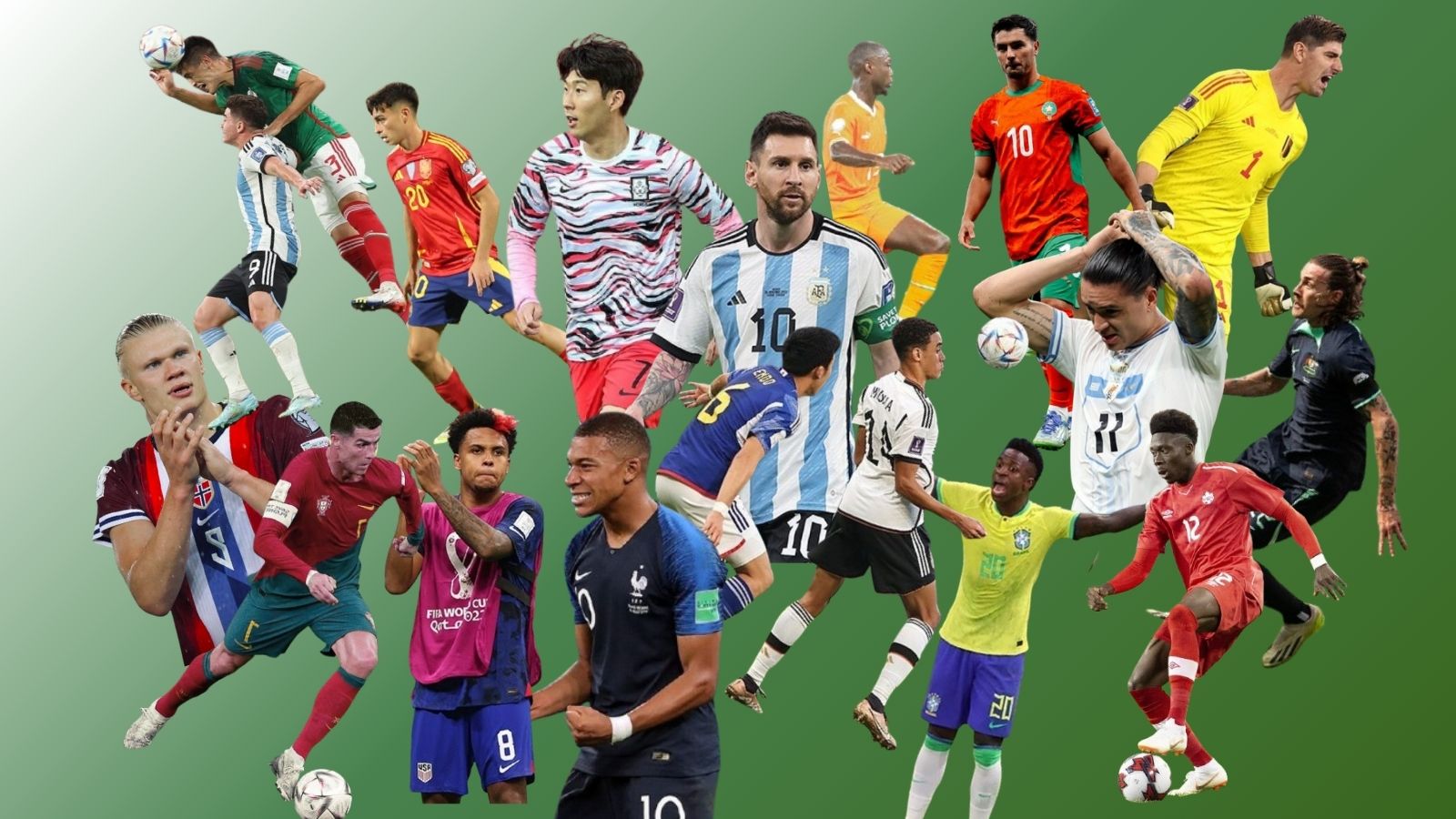
FIFA promised that this summer’s World Cup would be the biggest spectacle in the history of sports. Despite their best efforts, it mostly was.
The 2026 World Cup: 8.1
It is inarguable that the 2026 World Cup delivered more World Cup than ever before. There were 16 more teams, 60 more matches, and 136 more goals than the previous edition.
We were reminded constantly of this moreness, in particular by FIFA president Gianni Infantino, who positioned himself in the best seat in the fanciest box of every stadium he could feasibly get to and always found a friendly microphone to which he could tell the world how well this whole thing was going.
And for the most part, he was right. But it’s not like he should take credit. The 2026 World Cup was a great tournament, largely in spite of FIFA.
First the good: Any great sporting competition should be won by a truly great team, and the 2026 World Cup presented us with Spain. Soccer is a game of chaos, and particularly on the international stage it tends towards entropy. Many, perhaps most, summer international tournaments are won by teams that can harness that chaos in their favor, and can use it to create opportunities for their best players. That is, for example, how Argentina won in 2022.
But Spain were a team of complete control. No opponent could consistently get the ball away from them, let alone create any sort of chances to score. Anchored by one of the all-time great midfield anchor performances from Rodri, and aided by Dani Olmo, Fabian Ruiz, and Pedri all buzzing around him, completing passes and winning the ball in the press, Spain were always in complete command of their environment.
Spain’s great achievement was taking so much of the randomness out of a game defined by it. Usually soccer is like if to win a chess match, you also had to get all 7s on an adjacent slot machine. It’s about the combination of intricate and complex tactical systems and whether or not the ball bounces off a dude’s face and into the goal or out of play. For 750 minutes of a North American summer, Spain made it into simply chess, and they won.
But the World Cup belongs not just to the victors, but also to the wider storylines, including the villains. And so a brief word on Argentina, a team that was the perfect antihero for the tournament until they played too far into the stereotypes in the final.
For a long time, people will think of 2026 Argentina as a team that nearly won a World Cup because of favoritism from the referees and a team that they hated because of their on-field behavior and because of a confluence of real and projected political beliefs that are increasingly making people who normally don’t engage with the sport post about how the team is some sort of incarnation of the devil.
It’s probably good, narratively speaking, for the World Cup to have a villain. But behind all of the internet furor, this was a genuinely impressive, borderline miraculously good run from Argentina. There is an argument that this was Leo Messi’s best tournament. He was past his prime four years ago, yet at 39 he was the central — and arguably only — creative attacking nexus for a team that outplayed everyone they came across for a month.
Argentina didn’t get to the final because the strings were pulled their way. Argentina got to the final because for all of June and most of July, Leo Messi got on the pitch, directed traffic and they created more chances and better chances than their opposition could.
But they didn’t outplay Spain in the final. In fact, they barely played at all. For nearly two full hours of soccer, Argentina were unable and unwilling to string together any meaningful possession or create a single shot on goal. That they didn’t seem to attempt any soccer in the final is one of the few on-the-pitch negatives for the tournament, but also a reminder of just how good Spain were defensively.
Aside from that thud of a last performance from Argentina, there were very few disappointments in terms of the actual play. For the most part, a 48 team tournament proved a success, with many of the biggest underperformance coming from teams that would have been part of a 32 team World Cup. South Korea threw away a promising start to the tournament to play terrible football for two games and miss out on the knockout rounds. A talented Turkiye team were eliminated before the group stage even ended after two unlucky and guileless wins.
Portugal are probably the tournament’s biggest disappointments, but the psychodrama of their summer provided its own rich storyline. The tension between a desire to play Cristiano Ronaldo’s remaining strengths, and the fact that focussing on the strengths of their greatest ever player was increasingly becoming a hindrance to an incredibly talented roster, made every Portugal match a compelling and somewhat confusing viewing experience. It was like the second act of a Greek tragedy, in which the characters do the thing that was expressly forbidden by the gods. The temptation to cater to Ronaldo just proved too strong, and Roberto Martinez’s side were punished by the 2026 equivalent of a Zeus’s vengeful thunder — a late Mikel Merino winner.
The biggest negatives however, happened outside of the 90 minute intervals of global football celebration. There were the extortionate ticket prices, the never-ending fights over transportation fares, the endless barrage of advertising which intruded into the actual matches through the hydration breaks.1One thing I will miss about the 2026 World Cup is booing the hydration breaks, and the act of booing the hydration breaks as a way to see if I was with a crowd of truly locked-in soccer fans. Every time I heard others in the bar booing as the TVs cut to a David Beckham Lenovo ad in the 23rd minute, I knew I was in the right place.
Ahead of the tournament there were thousands of fans and even technical staff denied entry to the tournament. The Iranian team were treated with a stunning level of unfairness, forced to travel to and from Mexico on every gameday because the United States government decided they wouldn’t let the team stay in the States overnight. This on top of the fact that many of the players hadn’t played a competitive match in the better part of half a year prior to their opening game against New Zealand, on account of the United States being actively engaged in a bombing campaign against their country.
And always there was the threat of Donald Trump looming over the tournament. Aside from setting the immigration and tourism policies that threatened to make the World Cup a disaster, Trump seemed thankfully disengaged from the tournament — until he wasn’t.
We will probably never know the full truth about the suspension of Folarin Balogun’s red card. It’s in Donald Trump’s interest to lie about having pressured FIFA into taking action, since he loves to take credit for anything that broadly supports his image as the number one global bully. It’s in FIFA’s best interest to act like their obviously haphazard backroom process was above board. But the appearance of corruption can be as damning as actual proof in the public’s eye, and there is no doubt that the whole episode appears to be patently corrupt, a real negative mark on the actual sporting integrity of the competition.
But the lasting image of this World Cup, the one that sums up the perseverance of the sport despite it all, is Rodri politely waiting for Donald Trump and Gianni Infantino to get out of the way before he lifted the World Cup. It’s a perfect visual metaphor. Despite the clumsy attempts by American politicians and FIFA itself to ruin everything around the tournament, the soccer patiently waited for them to get out of the way, and for about a month it was almost perfect.
This was a World Cup of indelible star performances: Erling Haaland’s amazing American summer vacation and Jude Bellingham bursting through midfield and into English national team history. Kylian Mbappe’s march towards becoming an unparallelled international goalscorer and Lionel Messi’s last gasps of genius. It was the World Cup in which Rodri recovered from injury to put on a singular midfield performance, the totemic figure around which an all-time great team revolved.
It was a World Cup of incredible fan communion: The Dutch marching through Kansas City, the Scottish taking over Boston, the Norwegians rowing up and down the East Coast. Every city where Argentina or Colombia or Brazil played became Buenos Aries or Bogotá or Rio de Janeiro for 48 hours.
It provided amazing moments for the hosts of the part, too: Mexico fans throwing giveaway sombreros in the air after an opening win against South Africa and USMNT fans belting “Country Roads” after a first knockout win in a quarter century and Canada fans packing into stadiums to see their team’s best-ever men’s World Cup.
It was a tournament where after decades of being the most underrepresented continent at the World Cup, 10 African teams were finally allowed into the party, and almost all of them made it into the knockout rounds.2I really thought Tunisia were going to be defensively solid. What happened there?
And it was a World Cup of unforgettable great matches and moments. For 90 minutes in Mexico City, England and Mexico played a game that brought the energy of the Concacaf Nations League to the world stage, and that is the highest compliment I can pay to a soccer match. Cape Verde came within moments of pushing Argentina to penalties, and they did so on the back of the goal of the tournament, a curler from Sidney Lopes Cabral that etched its place into the history of the tournament the moment it left the inside of his right foot. And plenty of random group stage matches I will be thinking about for the rest of my life, including a dizzying late night 2-2 draw between Iran and New Zealand played in front of a delirious crowd of Persian Americans cheering wholeheartedly for their team.
In four summers, FIFA will once again try their best to throw nonsense in the way of the best show on earth. They’re going to split it up between six countries on three continents, tacking on some commemorative games in South America to honor the tournament’s centennial while playing most of the tournament in Iberia and Morocco. They’re going to consider expanding the field to 64 teams. They’re probably going to bring back hydration breaks, and figure out more ways to ensure every single penny generated at the tournament goes back to their operating fund in Switzerland instead of any of the host countries.
But none of the machinations around the tournament are more powerful than the force that is unleashed when the entire world converges to play the one stupid, chaotic, frustrating, occasionally sublime game that billions of us are hopelessly obsessed with.
In 2026, the winner of the World Cup was the World Cup. And you wouldn’t bet against it in 2030 either.